Anyone who runs a site about books knows the quiet frustration of a good page that nobody finds. You wrote a careful review of a new memoir, or you built a reading list for first-year students, and the page sits on page four of Google while a thin listicle from a bigger publisher takes the click. Books and publications are a crowded topic, and most of the traffic goes to sites that already have links pointing at them. That is why some owners of reading blogs, small imprints and independent bookshops start to look at paid links, and why it is worth doing the math before you commit to anything.
This article walks through one specific offer, the PBN Basic package on the PBN textlink page at Backlink247, and asks a plain question: what does it take to say yes, and who should say no?
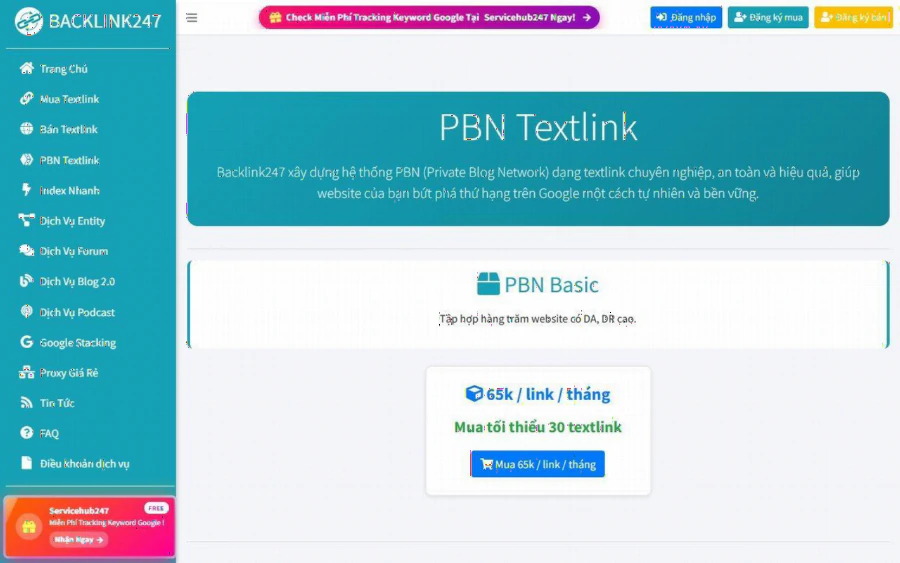
The Backlink247 PBN Textlink page showing the PBN Basic package at 65k per link per month with a 30 textlink minimum
What the page actually says
Let me stick to what is printed on the page, because that is all a buyer can verify before paying. The page is titled "PBN Textlink" and says Backlink247 builds a private blog network of textlinks, described as professional, safe and effective, to help a site climb on Google. There is one package, PBN Basic, described as "hundreds of websites with high DA and DR". The price is shown as "65k / link / month", and the minimum order is 30 textlinks. There is a single buy button, plus contact options through Telegram and a Facebook fanpage.
Notice what is not on the page. There is no exact count of sites, no list of DR or DA values, no traffic figures, no topic categories, no language filter, no refund terms and no delivery timeline. The page does not even name the currency behind "65k", although the rest of the site quotes its top-up offers in Vietnamese dong. So the first honest takeaway is this: PBN Basic is a bulk package where you buy a quantity, not a menu where you pick each site. If you want to choose where your link goes, the marketplace section works differently, and I will come back to it below.
The budget math for a small book site
The arithmetic is simple, and that is useful. Thirty links at 65k each, for one month, is 1,950,000 on the page's own terms. If the figure is in dong, as the rest of the site suggests, that is under two million dong a month. If you keep the links for three months, you are at 5,850,000. The "per month" in the price matters: this is a rental, not a one-off purchase, so the cost repeats for as long as you want the links to stay.
Now put that next to a typical book site. Suppose you run a review blog with about forty posts, and your best earner is a reading list that brings a few affiliate clicks a week. Before you spend 1,950,000, ask what one extra reader is worth to you. If a bookstore customer is worth a few dollars of margin, you need a lot of new visitors to repay a monthly bill of that size. A rough break-even check takes two minutes: divide the monthly bill by what one visitor or one sale earns you, and see whether the number looks believable for a month of extra rankings. If the answer is "I would need a hundred new buyers," then PBN Basic is probably the wrong tool for your stage.
A second, quieter cost is the 30 link minimum itself. Thirty links to one small site is a lot. A book blog with a dozen pages cannot naturally absorb thirty paid links, and you would need to spread them across several pages, with different anchor text, to avoid an obviously uniform pattern. That is a planning job that costs time, and the package does not do it for you.
What the PBN label means, and the risk you take
A PBN, short for private blog network, is a group of websites controlled to pass links to other sites. Think of it like a set of notice boards run by one person: every board points to the shop you want to promote. The appeal is control and speed. The risk is that search engines have long treated manipulative link schemes as a problem, and a network built for passing links is easier to spot than a link a real editor placed because your page was useful.
I am not going to promise that this will help or hurt your rankings, because nobody can promise that honestly. What I can say is that the downside is not symmetrical. If a link does nothing, you lose the monthly fee. If a network is later discounted or penalized, you may also have spent months building a link profile that you now have to clean up. The site's own FAQ library includes an entry on removing bad links through Google Search Console, which tells you the platform knows cleanup is part of the real world.
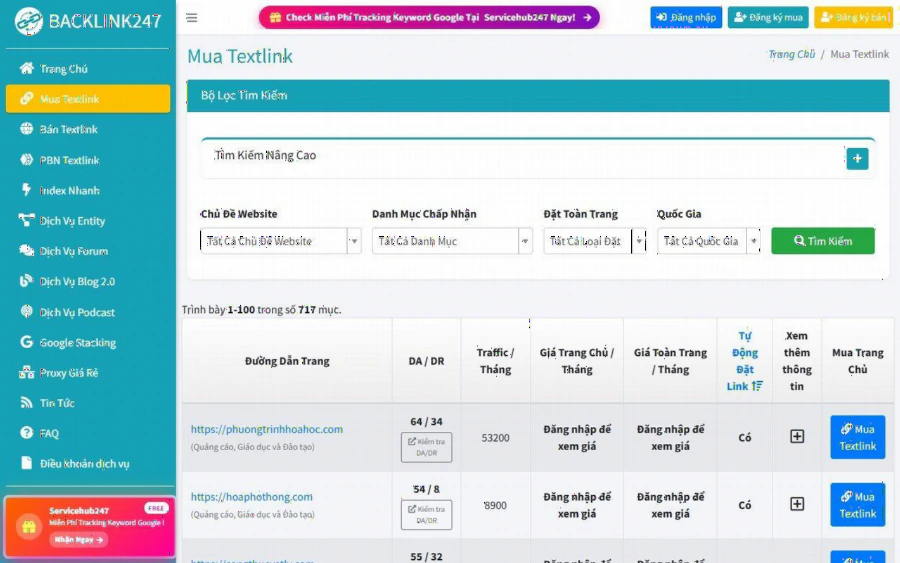
The Backlink247 marketplace page listing 717 sites with filters for DA, DR, traffic, topic and country
The alternative on the same site: pick your own placement
If paying a flat rate for a block of links feels too blind, the marketplace on the Mua Textlink page works the other way around. At the time of checking, it listed 717 items, with 100 shown per page. The filters let you set minimum and maximum DA and DR, minimum and maximum monthly traffic, the website topic, the accepted categories, single page or whole site placement, and country. Each row shows the page URL, DA and DR, monthly traffic, and a button to buy. Prices for both homepage and full site placement are hidden behind a login, so I cannot quote them here.
For a book site, this is the more natural starting point. You can filter by topic, check the traffic column, and look at a handful of sites in education or publishing before you spend. The page shows examples with very different quality: one education listing has DA 64, DR 34 and 53,200 monthly traffic, while other rows show a DA of 1 or traffic under a hundred. That spread is the real lesson. Numbers on a list are a starting point, and you still need to open the site, read it, and ask whether a reader of your book review would find a link there sensible.
The FAQ section also lists a first-time offer of one free textlink for newly registered accounts, with the details inside the linked article. For a cautious buyer, a single test link teaches you more about the process than any sales page, and it costs nothing but a few minutes.
Who should and should not use PBN Basic
PBN Basic can make sense if you already know what you want, you manage several sites or many pages, and you are comfortable with link building as a monthly operating cost. An agency handling a book retailer's catalog, for example, might have enough pages to spread thirty links sensibly, and the flat 65k rate makes budgeting easy.
It is a poor fit if you run a single small blog, if you want to choose each referring site, if you need clear refund terms in writing before paying, or if your site depends on a clean reputation, such as a publisher whose authors, schools and libraries will look at who links to you. For those cases, the marketplace with filters, or earning links through reviews, author interviews and genuine partnerships, is a safer bet.
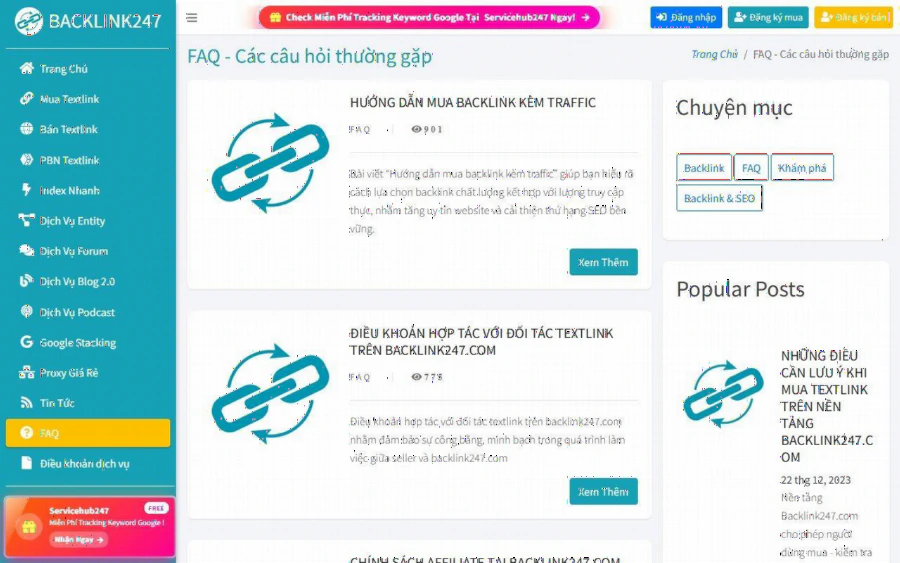
The Backlink247 FAQ page with articles on buying backlinks, partner terms and refund policy
A practical way to start
First, read the FAQ articles on textlink checking and refunds before you put in any money, because the PBN page does not state them. Second, register and look at the actual prices, since the marketplace hides them until login. Third, run a small test: one link, one page, one clear goal, such as a single reading list you want to move from page three to page two. Fourth, write down your starting position in a spreadsheet, the date, the page, the keyword and the current ranking, so you can judge the result in a month with numbers instead of hope.
If the test shows a signal, you can scale up. If it does not, you have spent very little and learned how the platform works. That discipline, small test first and bulk later, is the real budget advice for any book site. The PBN Basic package is an honest, clearly priced bulk offer, but whether it is worth 1,950,000 a month depends on your pages, your margins and your tolerance for risk, not on the label on the box.